
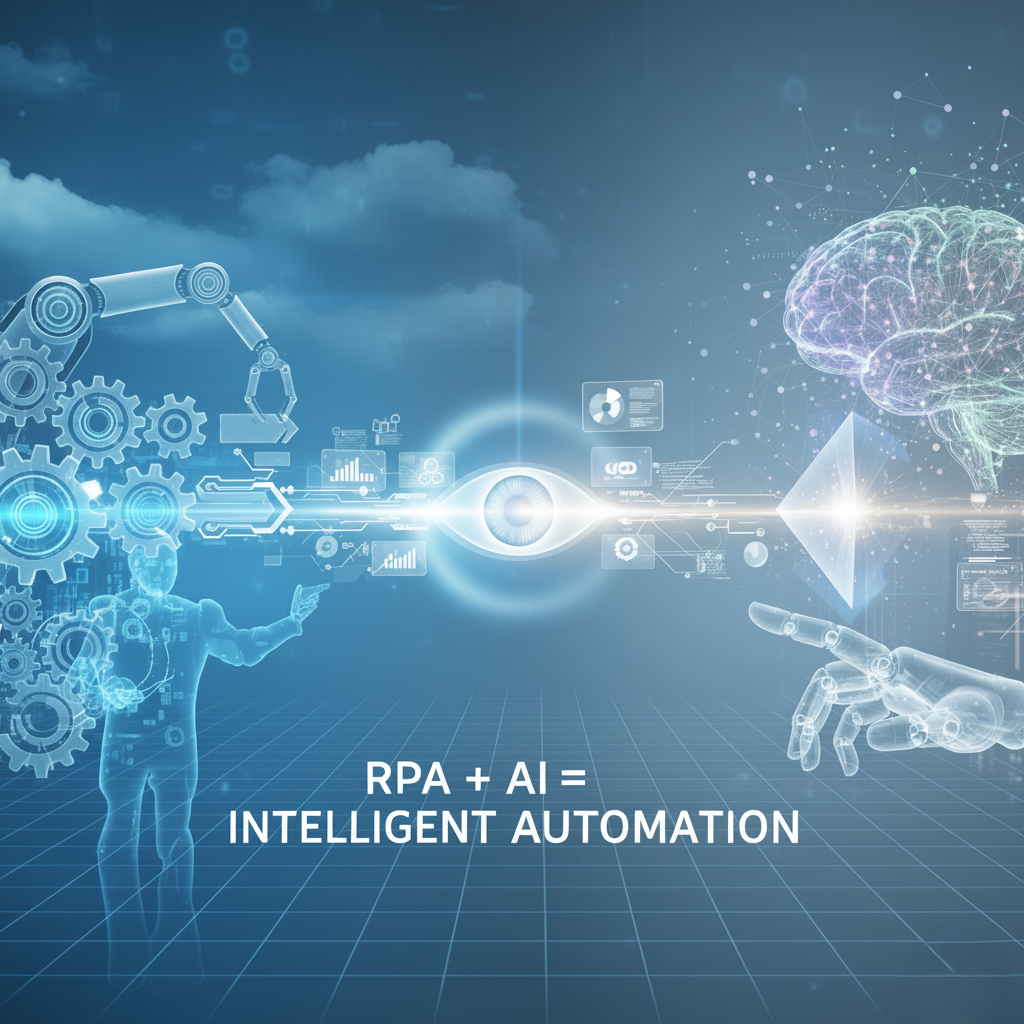
Robotic Process Automation (RPA) provided the first wave of enterprise efficiency by automating repetitive, rule-based tasks. However, its limitations in handling unstructured data and complex decision-making have become clear. The future of automation lies in Cognitive Automation: the powerful convergence of RPA's execution speed with Artificial Intelligence's ability to reason, learn, and adapt.
The RPA Plateau: Why Bots Need Brains
Pure RPA bots excel at logging into systems, moving files, and processing structured data like spreadsheets. But they halt when confronted with typical business scenarios:
- Interpreting the intent of a customer email (unstructured text).
- Validating identity documents from various formats (image processing).
- Making a complex, variable decision based on changing compliance rules.
This "last mile problem" means human intervention is still required, breaking the end-to-end automation promise.
Cognitive Automation in Practice:
A cognitive bot can read a vendor invoice, extract the total using OCR/NLP, classify the expense type using Machine Learning, and then enter the data into the ERP system via RPA all without human touch.
Pillars of Cognitive Automation
Cognitive automation integrates several AI technologies to augment the core capabilities of the RPA robot:
1. Natural Language Processing (NLP)
NLP allows bots to understand, interpret, and generate human language. In customer service workflows, NLP routes complex queries from emails or chat logs, extracts key entities (like customer name, account number, or complaint type), and feeds these variables to the RPA bot for execution. This transforms unstructured data into actionable inputs.
2. Computer Vision and Intelligent Document Processing (IDP)
IDP combines Optical Character Recognition (OCR) with AI models to handle semi-structured and unstructured documents (invoices, receipts, contracts). Unlike traditional OCR which relies on fixed templates, IDP can dynamically locate and extract data fields from documents it has never seen before, making processes like loan application processing and compliance checks scalable across diverse document sets.
3. Machine Learning (ML) for Decision Making
ML algorithms enable the bot to learn from historical outcomes. For example, in credit risk assessment, the bot performs the data gathering (RPA), but the decision to approve or flag the application is made by a predictive ML model based on thousands of prior cases. This introduces judgment and continuous improvement into the process.
Designing the Seamless Workflow
The synergy is achieved by creating an orchestrated workflow where the AI component performs the cognitive task (reading, thinking, deciding) and the RPA component performs the physical task (clicking, typing, communicating).
// Conceptual Cognitive Workflow
function processCustomerComplaint(email_text) {
    // 1. AI: NLP interprets and classifies intent
    const intent = NLP_SERVICE.classify(email_text); // e.g., 'Refund_Request'

    // 2. AI: Extract key data
    const customer_id = NLP_SERVICE.extractEntity(email_text, 'CustomerID');

    // 3. RPA: Execute transactional steps
    RPA_BOT.login('CRM_System');
    RPA_BOT.search(customer_id);

    // 4. AI: Decision based on business rules and historical data
    const refund_amount = REFUND_ML_MODEL.calculate(customer_id, intent);

    // 5. RPA: Complete the loop
    RPA_BOT.inputRefund(refund_amount);
    RPA_BOT.sendEmail(customer_id, "Your refund is processed.");
}
// This entire process is non-stop, adaptive, and fully automated.
Conclusion: The Hyper-Automated Enterprise
Cognitive automation is the bridge to the Hyper-Automated Enterprise. By unifying AI's intelligence with RPA's execution capabilities, organizations can automate 80-90% of complex, knowledge-intensive processes, not just the simple, repetitive ones. This convergence frees human teams to focus entirely on innovation, customer strategy, and complex problem-solving, driving both efficiency and competitive advantage in the digital economy.